 Skip to content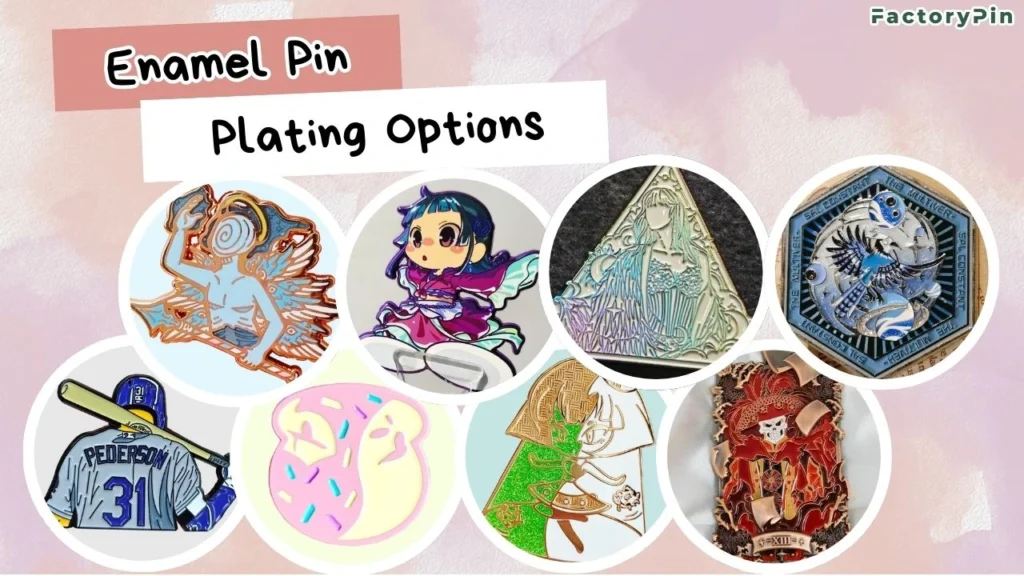
When customizing enamel pins, plating option is one of the most important—but often overlooked—decisions. While most people focus on colors, shapes, or artwork details, the plating finish plays a huge role in how your pin looks, feels, and ages over time.
Whether you’re creating soft enamel pins or hard enamel pins, this article is designed to give you a clear, practical understanding of your options—straight from real production experience.
Standard Plating Options: Gold, Silver, and Copper
Gold, silver, and copper plating are the most common and safest choices for enamel pins. These finishes are widely used, cost-effective, and suitable for both soft enamel and hard enamel pins.
Because the process is stable and well-established, the risk of production issues is relatively low.
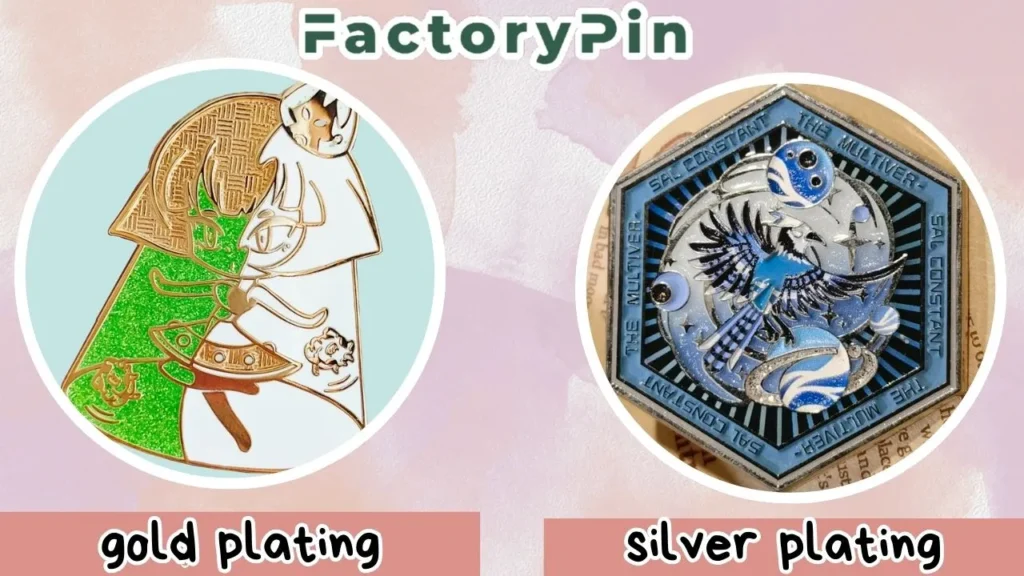
Gold Plating: Real Gold vs. Imitation Gold
One detail many customers don’t realize is that not all “gold plating” looks the same.
- Real gold plating tends to have a slightly darker, more subtle tone. It may appear less bright yellow, but it is more durable, easier to maintain, and resistant to oxidation.
- Imitation gold plating often looks brighter and more yellow but is less stable over time.
Real gold plating usually costs more, but it offers better long-term quality—especially for pins meant to be worn frequently or kept as collectibles.
Silver Plating and Nickel Plating
In enamel pin production, silver plating and nickel plating use the same base electroplating process. As a result, they typically have the same cost and very similar appearance.
Silver/nickel plating works well for clean, modern designs and pairs nicely with both bold and subtle enamel colors.
Black Nickel and Rose Gold Plating
Black nickel and rose gold plating are popular for more premium or fashion-forward designs, but they come with added complexity.
Both finishes require:
- Multiple chemical solution baths
- More precise control of time, temperature, and solution balance
- A protective oil coating to reduce oxidation
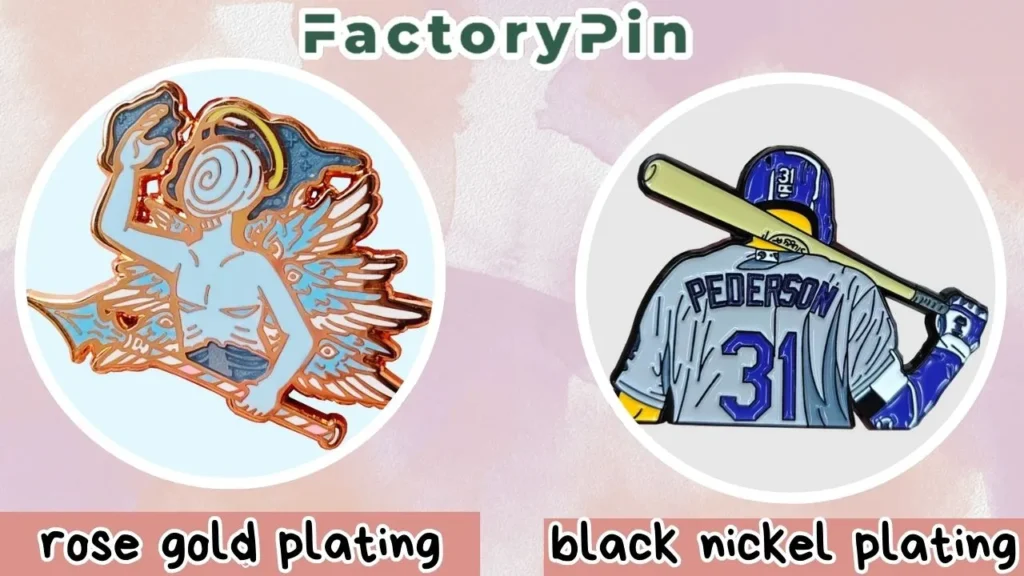
These plating options are suitable for both soft enamel and hard enamel pins, but they carry a higher production risk compared to standard gold or silver finishes. While factories work hard to minimize issues, chemical reactions are not always perfectly predictable.
Because of this, black nickel and rose gold plating are best reserved for designs where the visual impact justifies the added complexity.
Antique Plating and Rainbow Plating
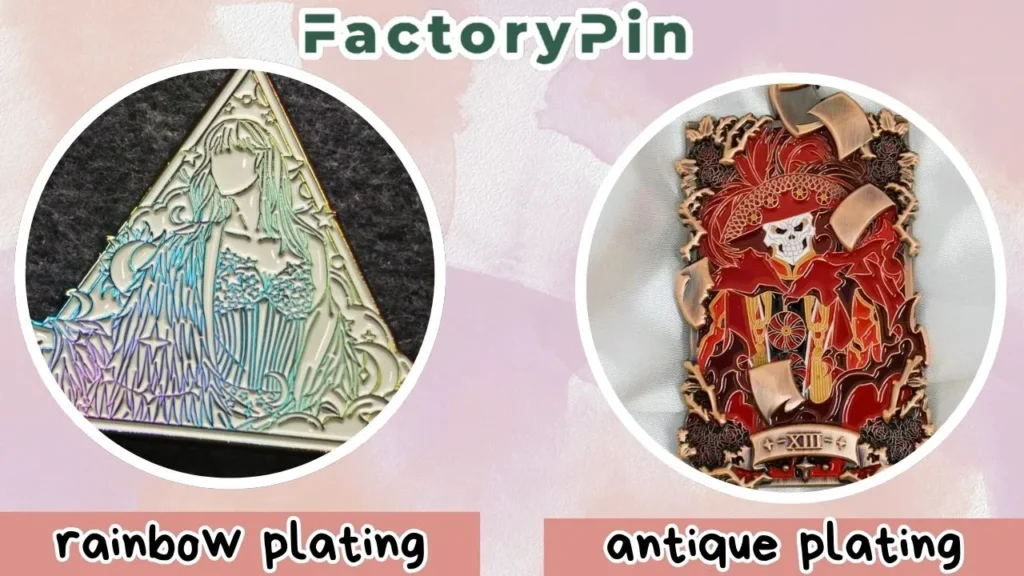
Antique Gold, Antique Silver, and Antique Copper
Antique plating finishes have a matte, aged appearance and are especially popular for:
- Military pins
- Commemorative badges
- Corporate or ceremonial designs
These finishes add depth and texture, making them ideal for designs that aim to look traditional or historical.
Rainbow Plating
Rainbow plating creates a multicolor metallic sheen that shifts under different lighting, similar to a rainbow effect. It’s bold, eye-catching, and often used for creative or artistic designs.
Enamel Compatibility
Antique and rainbow plating are typically recommended for soft enamel pins only. The chemical processes involved can affect the surface and color stability of hard enamel pins.
While exceptions may exist, they are less common and often come with higher risk and cost. For most projects, soft enamel is the safer and more reliable choice when using these finishes.
Anodized Chrome Plating
Anodized chrome plating is one of the most reflective and visually striking plating options available. It enhances metal shine and makes colors appear more vivid, which is why many anime-style and illustration-based designs are drawn to it.

However, chrome plating requires careful consideration.
When Chrome Plating Becomes Risky
Chrome plating is not ideal for designs that feature large areas of exposed metal on the front, where no enamel color is applied.
In these cases:
- Large metal surfaces are less forgiving
- Minor surface imperfections become more visible
- The risk of uneven plating increases significantly
As the exposed metal area grows, the chance of plating defects rises—regardless of whether enamel is used elsewhere in the design.
Because of this, chrome plating is better suited for designs with controlled metal exposure rather than large, uninterrupted metal surfaces.
Dye Plating
For designs with large areas of visible metal—especially on the front of the pin—dye plating is often a better alternative.
Instead of immersing the pin in aggressive chemical solutions, dye plating applies color through controlled surface coating techniques. This makes it:
- More stable
- Easier to control for uniform results
- Better suited for clean, consistent metal tones
Dye plating is commonly used when the design prioritizes appearance and consistency over extreme reflectivity.
Important note: Dye plating is only suitable for soft enamel pins.
Spray Metal Plating
Spray metal plating is another option exclusive to soft enamel pins, and it allows for more creative metal effects.
With this technique:
- Two or more metal colors can be applied
- Colors blend smoothly across the metal surface
- The result is a gradient metallic finish
Under sunlight or strong lighting, spray metal plating creates dynamic color shifts and enhanced visual depth. This option is especially popular among anime and illustration-focused designs that want something unique and expressive.
Final
If you’re not sure which plating option is right for your design—or if you’d like to understand the cost differences between finishes—feel free to reach out to our team.
We’re happy to review your artwork, explain the pros and cons of each plating option, and recommend solutions that balance appearance, production stability, and budget. In most cases, we can also provide a clear, itemized quote within a short timeframe to help you move forward with confidence.

